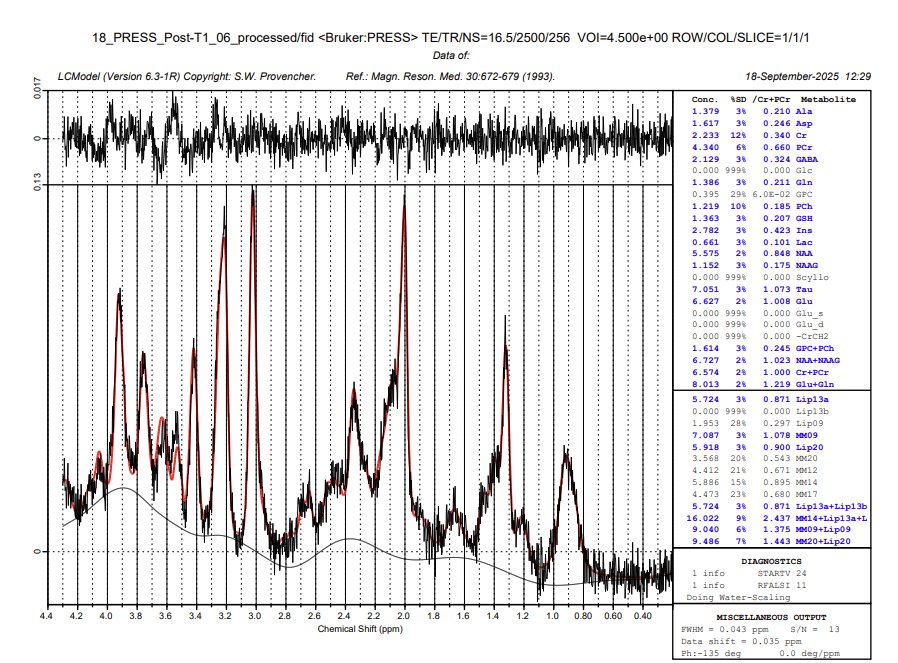
I’m analyzing a longitudinal single-voxel ^1H-MRS dataset (one baseline pre-infusion scan and ten post-infusion scans). In VESPA I generated three simulated glutamate bases—unlabeled, singly ^13C-labeled, and doubly ^13C-labeled—and built three full basis sets (including other metabolites). I then fit the same data three times, once per basis.
What I’m seeing:
Unlabeled glutamate estimates look reasonable.
The labeled glutamate components are consistently overestimated when I use their respective labeled basis sets.
If I combine all three glutamate variants into a single basis, only the unlabeled glutamate is detected (see attached screenshot), which is why I tried fitting separately.
Questions:
Is fitting three separate basis sets an appropriate approach for separating labeled and unlabeled glutamate, or should these be fit jointly with constraints?
If joint fitting is recommended, what constraints (e.g., shared line shape/shift, nonnegativity, coupling/ratio priors, or temporal smoothness across timepoints) help prevent overestimation of labeled components?
Hi @meera_s,
Since this is not a standard method, I have a few questions:
Is this a mouse spectrum? Which field strength (400 MHz)?
Which positions were labeled?
How does your spin system look like in VESPA?
Have you compared your simulated spectra with measured ones? For example, have you measured the labeled glutamate in solution?
Without ^13C decoupling, you will observe strong splitting of your patterns due to ^1H-^13C coupling, since the coupling constant is of a different order of magnitude compared to ^1H-^1H coupling. Have you checked whether your patterns appear in a spectral region that can be reliably evaluated?
As a first step, I would check whether your simulated spectra are comparable to phantom measurements. Next, I would look at the difference spectra (post-infusion - pre-infusion) to see whether an effect is visible. Is this consistent with your simulations (simulated labeled Glu - simulated Glu)?
Once you have confirmed the correct effect and ensured that your simulations are reasonable, you can move on to the appropriate evaluation strategy.