Hi @wclarke and @admin,
After working on another project and only intermittently on MRS, I can now focus again on the MEGA-sLASER analysis and basis set.
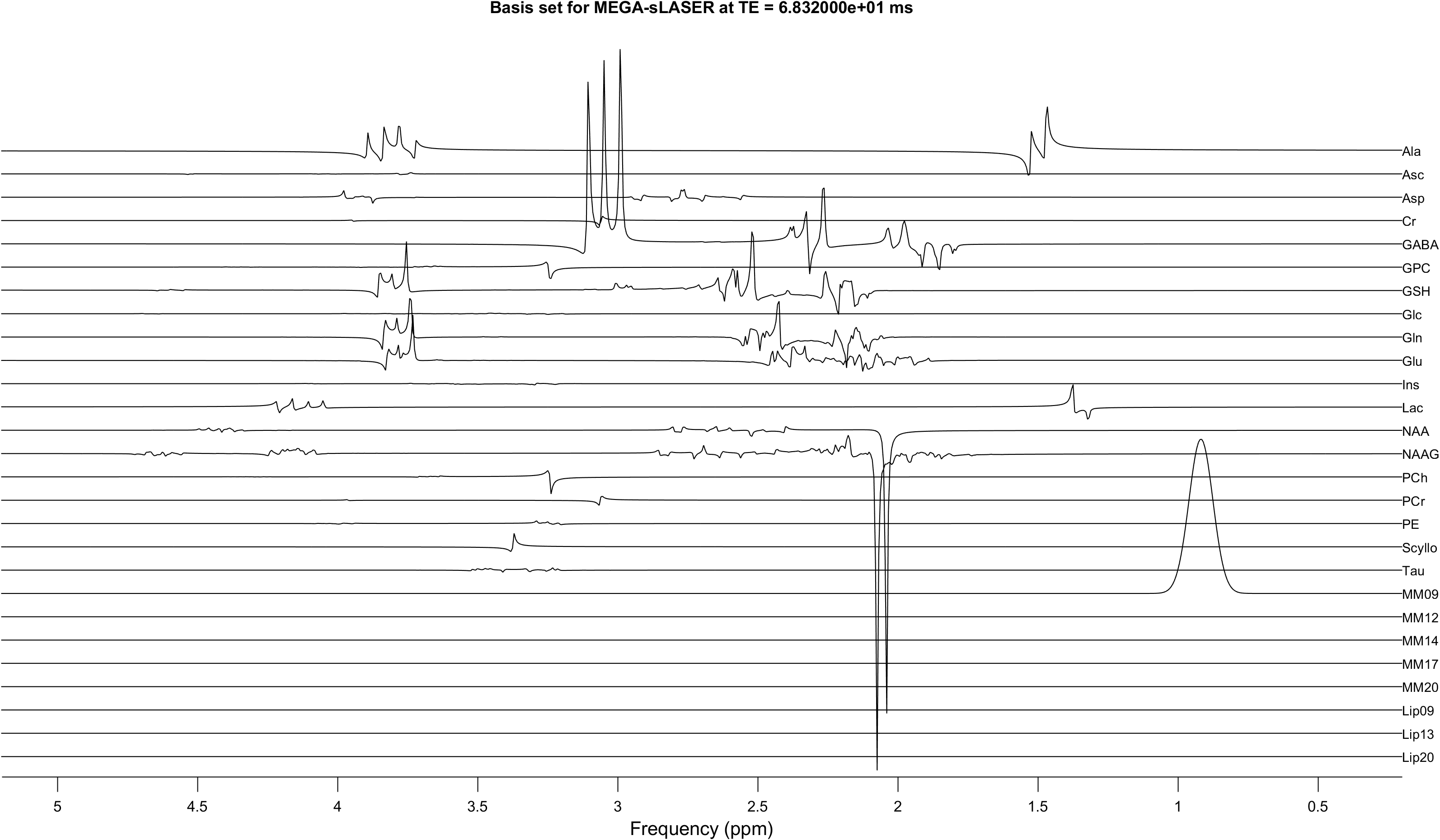
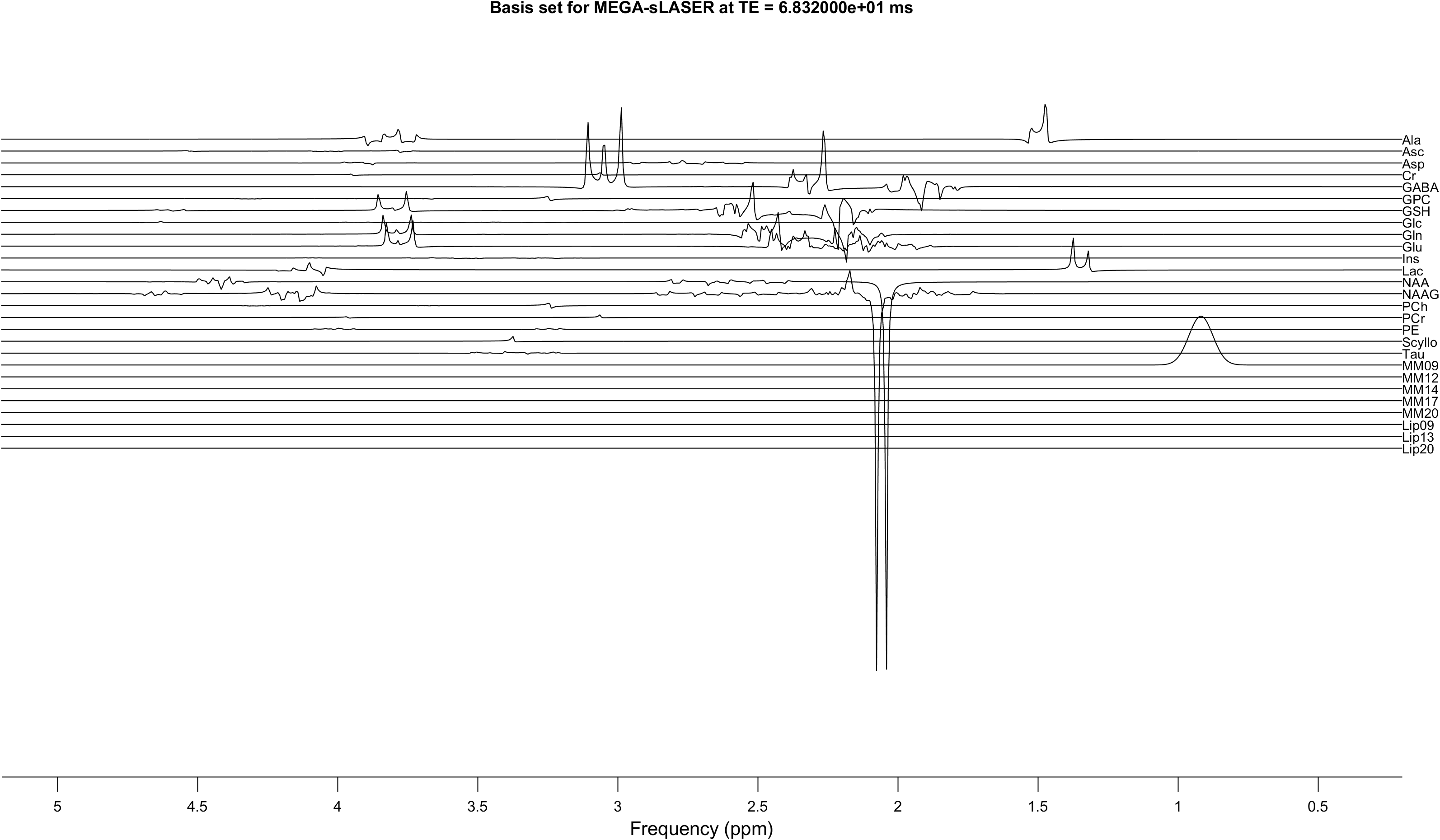
I managed to convert the FSL-MRS-generated MEGA-sLASER basis set into an Osprey-readable format. Briefly, I:
- converted the FSL-MRS ON/OFF basis folders into FID-A format
- combined ON/OFF into a single file per metabolite
- imported these into Osprey to generate a
.basis file
I also had to manually add a water peak, otherwise Osprey complained about the basis set (details below).
I tested this basis in both Osprey and FSL-MRS using pilot in vivo data and a custom GABA phantom. So far, the fits are not very good (especially around the 3 ppm region and where the co-edited MMs would be).
At the moment, I have not included any co-edited MM/lipid peaks, and I suspect this is part of the issue. I tried:
- adding MM peaks in FSL-MRS
- letting Osprey add MM components
but this has not clearly improved the fits yet.
Questions
1) MM/lipid modeling
What would be the recommended way to include co-edited MM/lipid basis functions for a MEGA-sLASER basis generated with FSL-MRS?
Specifically:
-
Should MM components be simulated, added empirically, or taken from existing Osprey basis sets?
-
My understanding is that for edited MEGA data, simply adding generic MM basis functions may not be sufficient, since the edited GABA signal includes a co-edited MM contribution?
Would you recommend explicitly modeling co-edited MM (e.g., MM3co/MM09), and if so, how should this best be implemented when starting from an FSL-MRS simulated basis?
2) FSL-MRS preprocessing
For FSL-MRS, I used the standard preprocessing pipeline for edited sequences. This is likely not optimal for MEGA-sLASER.
Are there recommendations for preprocessing/analyzing MEGA-sLASER data in FSL-MRS?
The only relevant discussion I found was:
3) Basis set simulation parameters
I plan to refine the simulation and rerun the basis set with a higher spectral resolution. For MEGA-sLASER at TE ≈ 68.32 ms, which parameters are most critical to get right?
For example:
- exact TE (atm the basis set simulation is using 68 ms instead of 68.32)
- spectral resolution
- pulse bandwidth / shape
- excitation pulse duration (we had to increase it from the default values)
4) Splitting acquisitions due to frequency drift
We observe substantial frequency drift (~2.6 Hz/min) when running fMRI before the post-task MEGA-sLASER scan.
Splitting the acquisition into 2 × 4 min blocks and updating the frequency in between improved data quality.
What would be the best way to combine these blocks for analysis:
(i.e., should they be concatenated before fitting, or aligned and combined during preprocessing?)
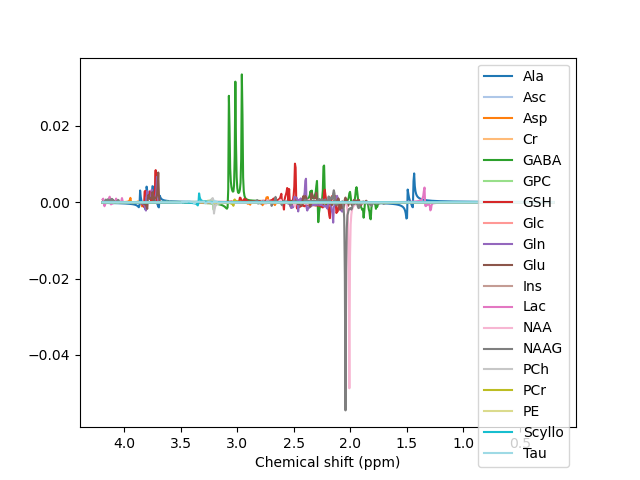
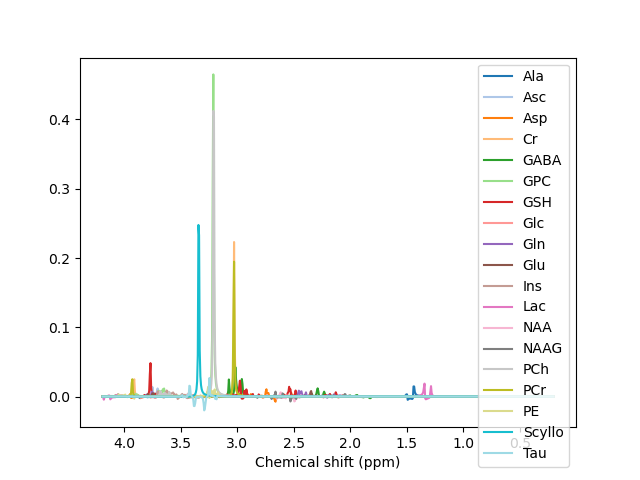
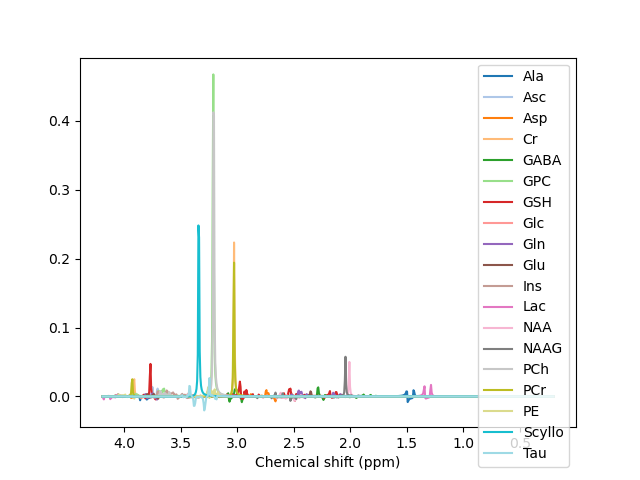
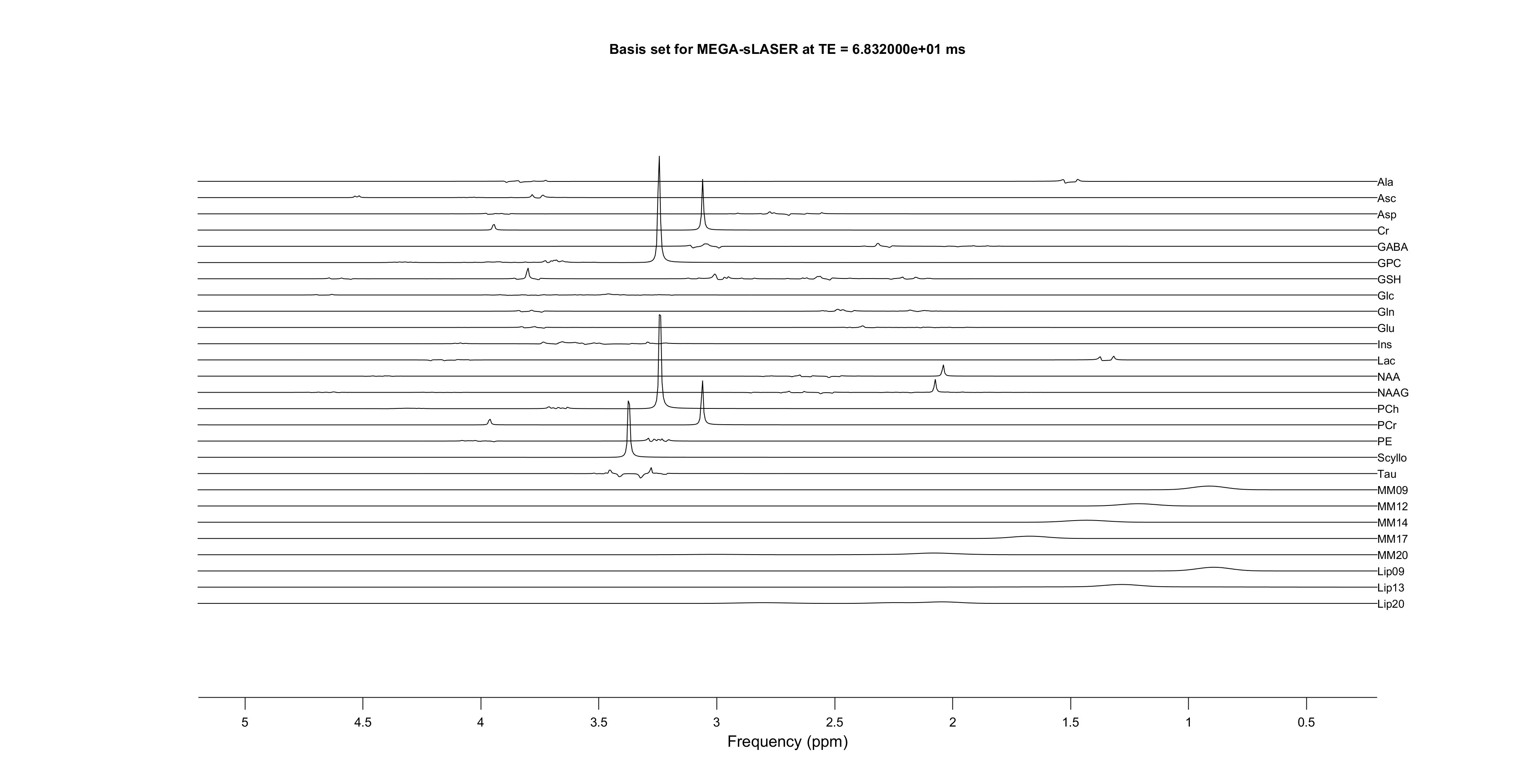
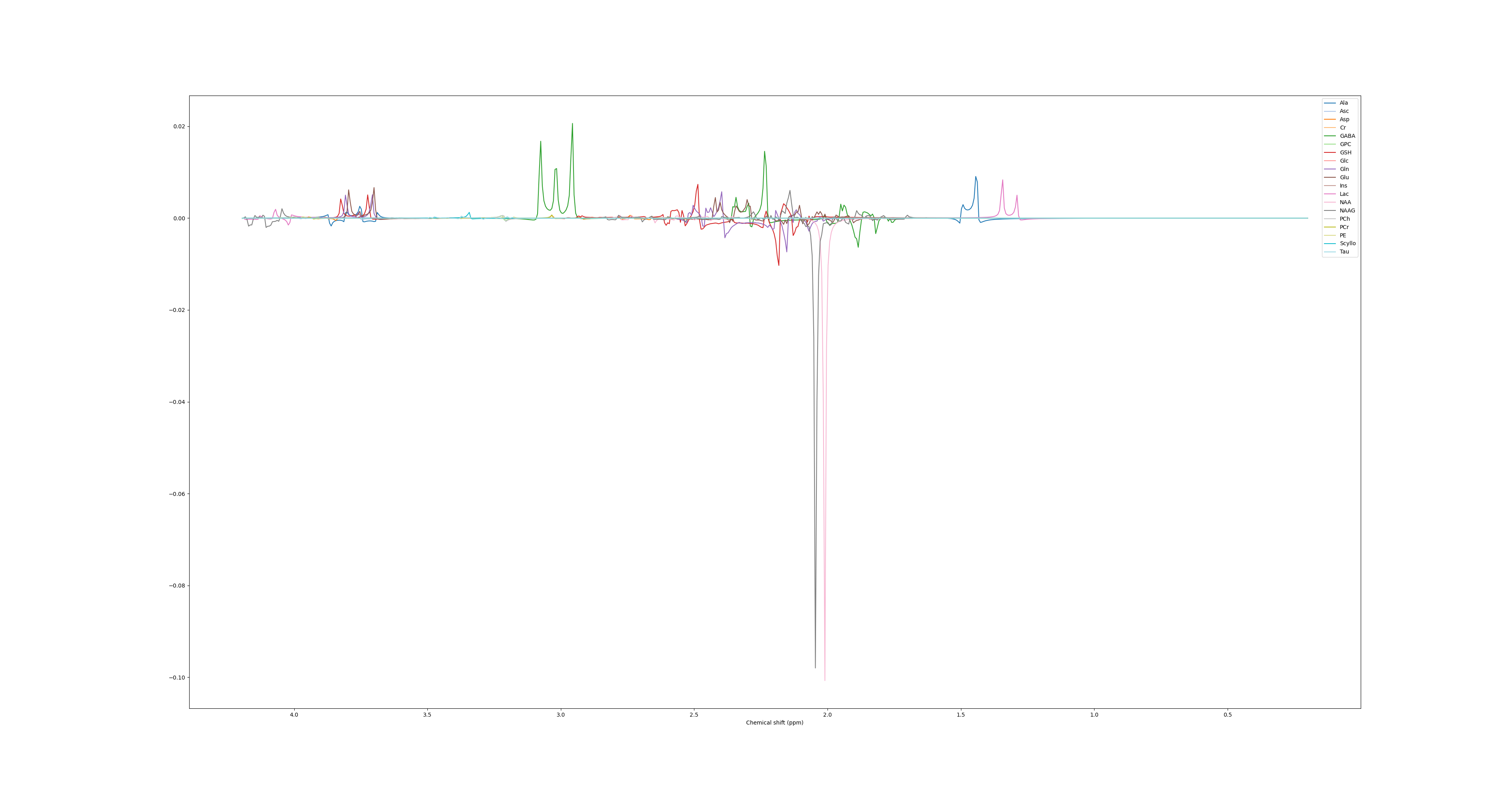
I’ve added the plots of the basis set from FSL-MRS and the imported Osprey basis set to the post at the end. I’m happy to upload the full FSL-MRS and Osprey basis sets if that would be helpful.
Thank you for your help in advance!
Best,
Thomas
P.S. @wclarke, I’m currently reading your Introduction to Magnetic Resonance Spectroscopy together with a PhD student I’m training - it’s a great resource. It would have saved me quite a bit of pain if it had been available when I started 
Water peak used for Osprey import:
waterPPM = 4.68;

waterFWHM = 0.05; % ppm

sigma = waterFWHM / 2.355;

spec = exp(-0.5 * ((ppm - waterPPM) ./ sigma).^2);

spec = spec / max(spec);
FSL-MRS Basis Set Plots:
Diff:
On:
Off:
Osprey Basis Set Plot:
 FSL-MRS doesn’t output DIFF