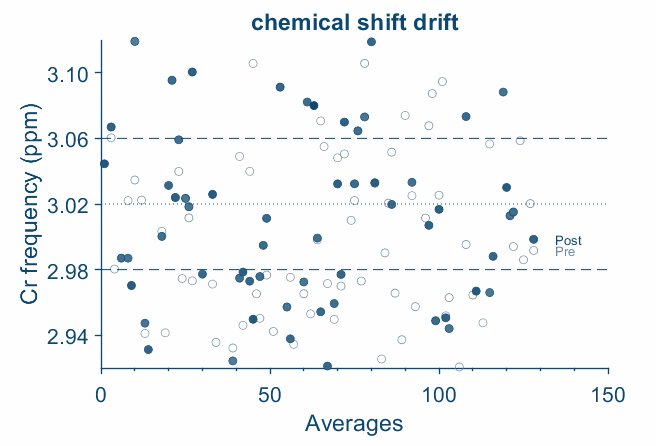
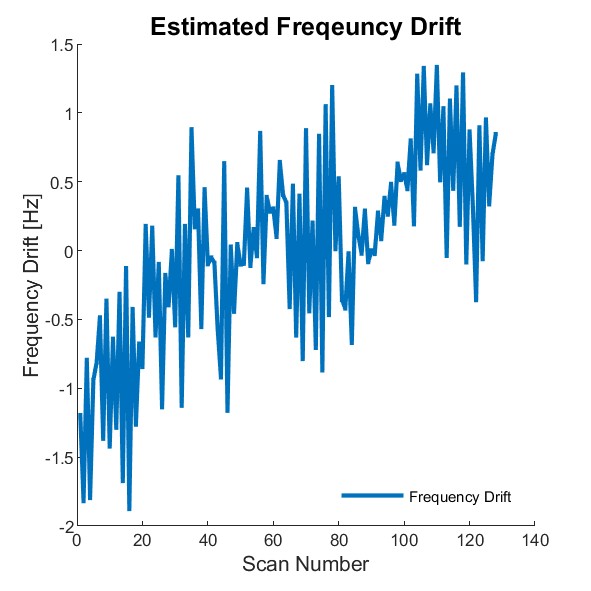
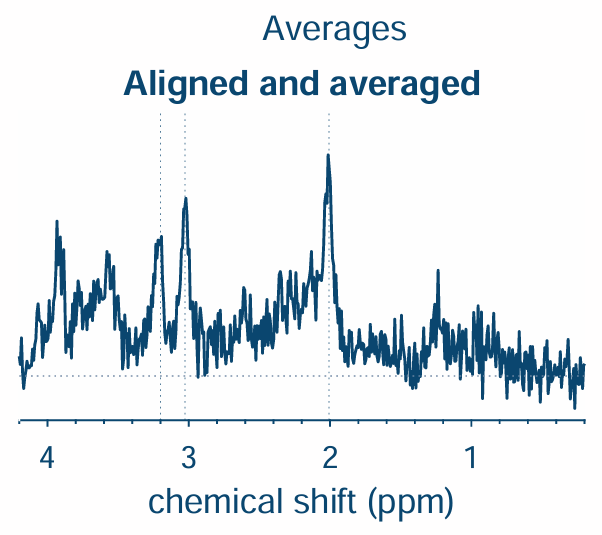
From our Osprey output, we are getting a lot of chemical shift differences in our data (although it should be noted when I use FID-A the drift on the water peak looks fine). I’m curious if anyone has seen this before and what could cause this? It is consistent across multiple datasets so it’s definitely not movement.
I see this often when the SNR of each individual transient is very low. Another reason could be if there are stimulated echoes outside the 0.5-4 spectral region that spoil the alignment procedure.
Thank you for your reply that’s really helpful! We have quite a small voxel so the SNR could definitely be it. Have you found any solutions to improving the alignment?
Unfortunately, alignment techniques do not work quite well when they don’t observe sufficient signals in individual transients.
Also I would have checked what does the suppressed water look like. Maybe this alignment in FID-A could work out better in this case.
If there are stimulated echoes (which may happen in small voxels) it could have been these echoes are stronger than the metabolite signals and are used for alignment instead of the metabolite signals. In this case, restricted spectral region could help for alignment (RestrSpecReg).
I don’t see any evidence of stimulated echoes in the data (screenshot of data attached), but I can give RestrSpecReg a try. Our linewidth is very high (which I’m working on reducing), which is likely causing problems too.
I would not say ‘very’ high, the Cho and Cr are resolved
It’s the SNR, our main limitation here.
If the water alignment works efficiently (you see that the data become improved), that’s great. One more approach that might work is to align transients after group-averaging them. Let’s say you have 128 acquisitions. You can split them into groups of 8 (average these 8 transients), find the shifts between these groups and apply these shifts to individual transients. This can be repeated iteratively.