In two of eight recent Siemens PRESS acquisitions, Osprey’s alignment of individual transients from the twix file has made the final aligned and averaged spectrum worse (higher FWHM and worse CRLBs) than the averaged spectrum fit by LCModel using the vendor RDA file. For the other six of our recent PRESS acquisitions, we get much better final spectra using the twix files than using the RDA file.
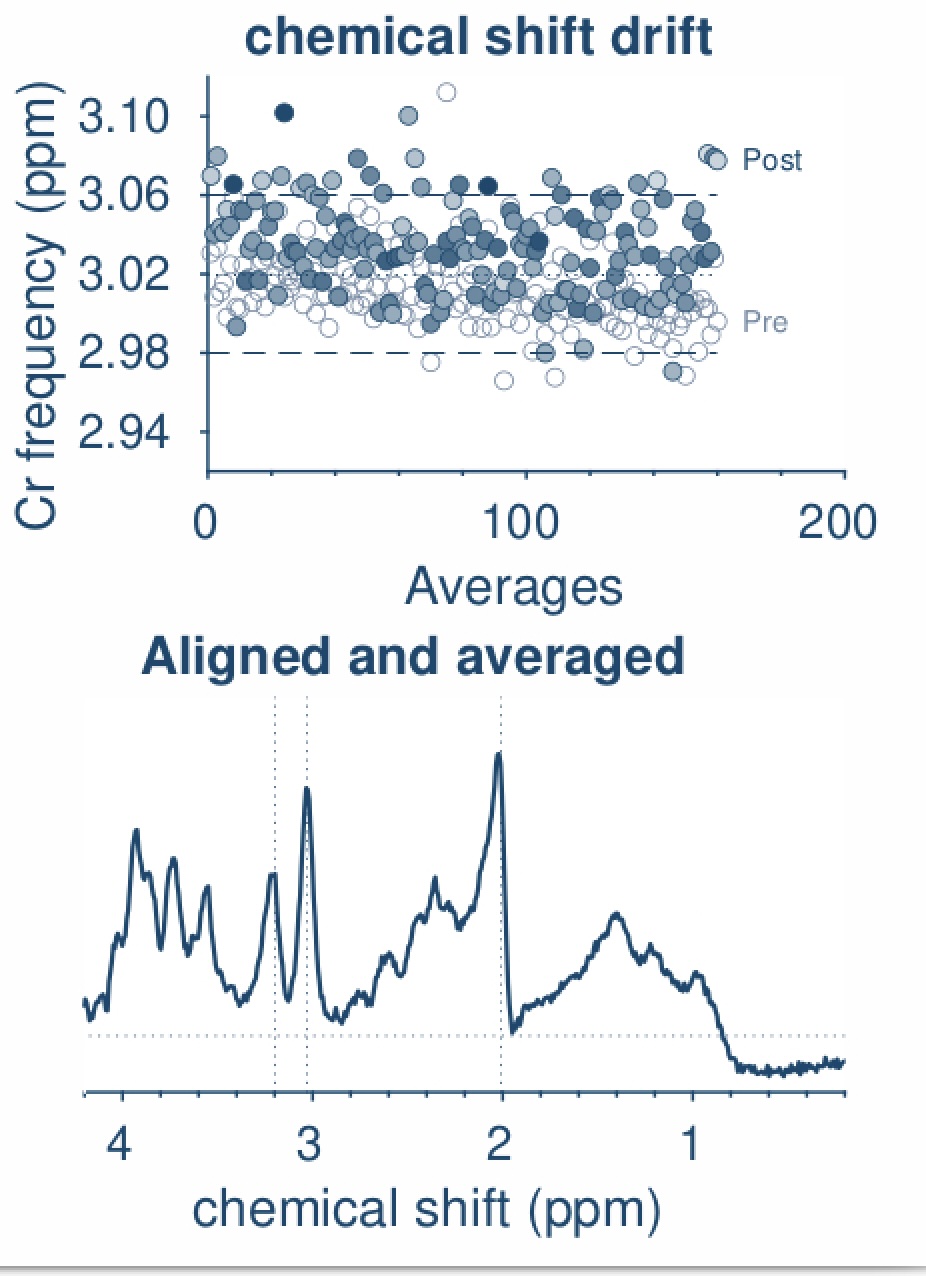
Below is the Chemical Shift Drift graph showing drift before and after alignment when processed using default settings in the GUI (RobSpecReg, L2Norm, ECC). The tCr FWHM = .082 ppm and the tCr SNR = 102.8. Alignment seems to have made the drift worse. The aligned and averaged spectrum is not very good.
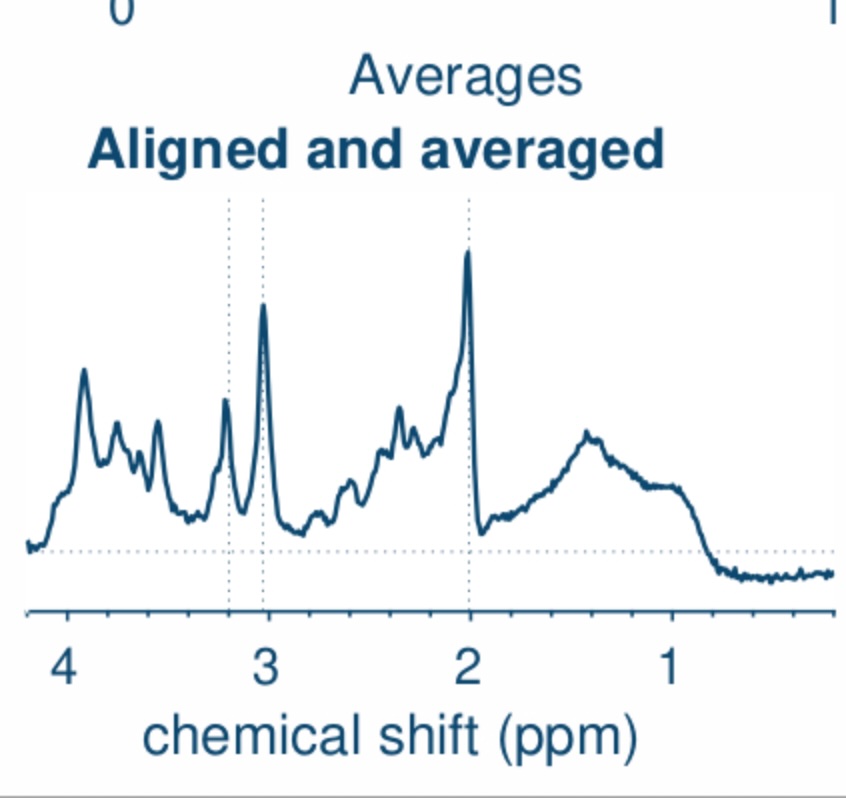
Shown below that is the spectrum from the vendor RDA file. The tCr FWHM = .063 ppm and the tCr SNR = 125.7. These are not great values, but they’re better than the aligned and averaged spectrum generated from the twix file.
So far, I only know how to use Osprey from the GUI. I’ve tried every alternative to the defaults in the GUI for spectral registration and alignment. Only the ProbSpecReg alternative improved the drift pattern and the final spectrum, but it still wasn’t as good as the spectrum from the RDA file.
Does anyone know if I am doing something wrong here, or why this problem is occurring?
Thanks for your patience - I’m just catching up on MRSHub posts after a really busy month.
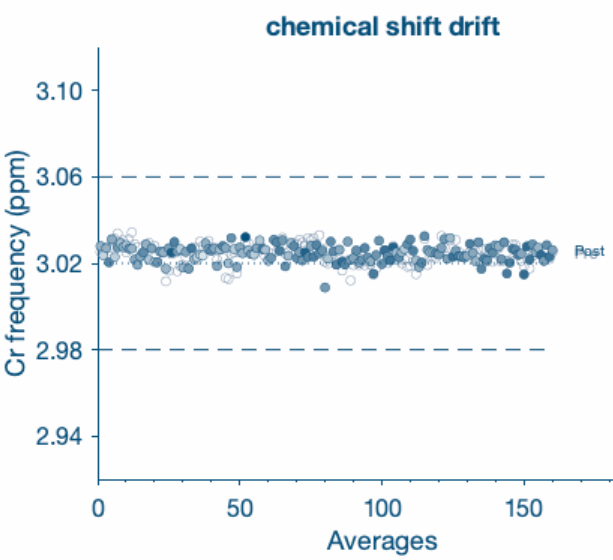
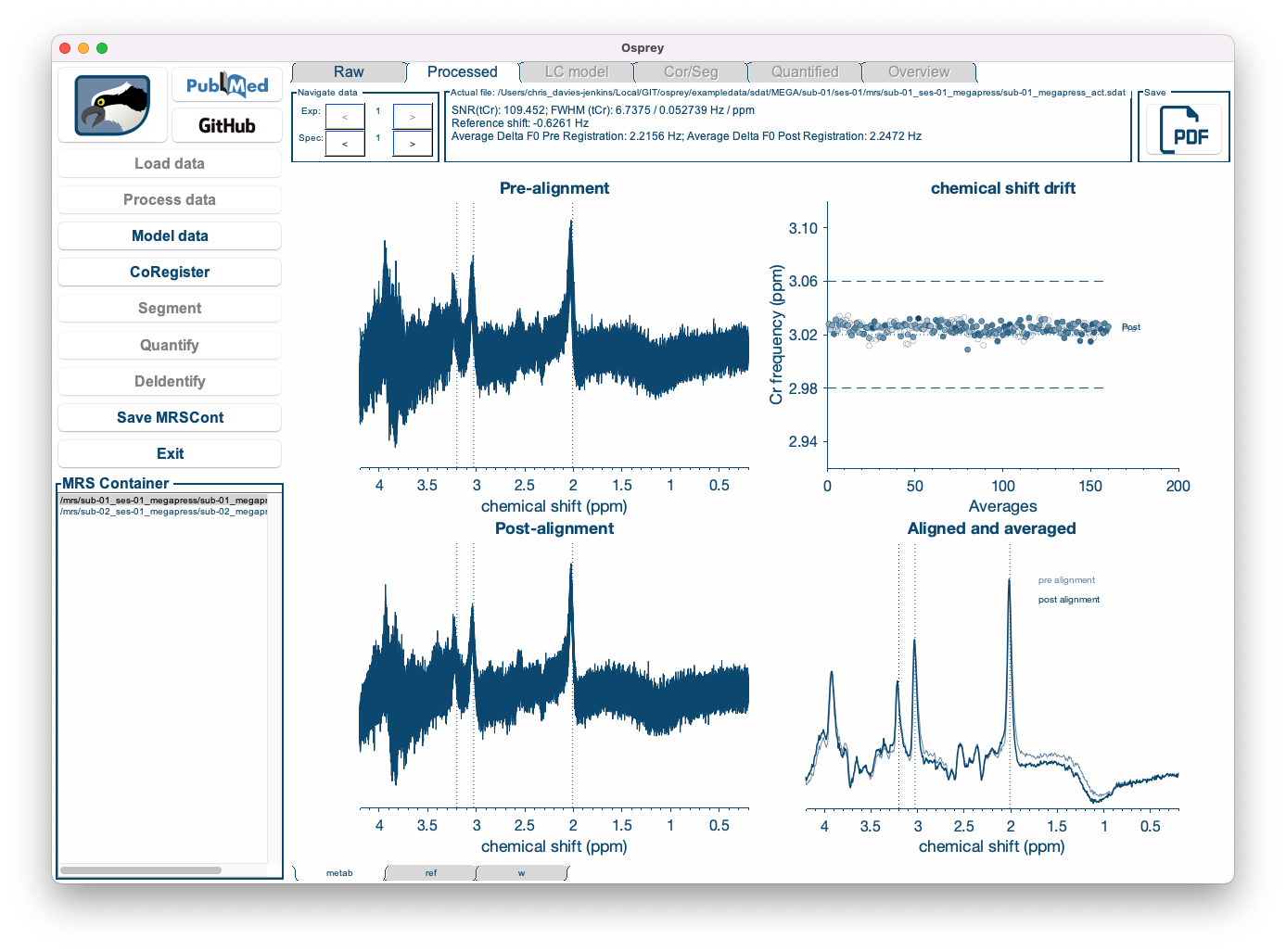
We’ve also seen spectral alignment algorithms struggle if the single-shot transients are very noisy. A good tell-tale sign of ‘too noisy’ is when the estimation of the maximum of the tCr peak is as wobbly as in your case. Compare this to high-SNR single-shot data (source: Osprey documentation):
We’ve not really systematically investigated how much single-shot SNR is sufficient to reliably not ‘break’ the alignment routines and make things worse. In the context of our recent paper on model-based frequency/phase correction, things start to really fall apart (Figure 3) if you go below a single-shot SNR of \frac{32}{\sqrt{64}} (SNR level 4 in the paper), but that’s still below your single-shot SNR (approx. \frac{125}{\sqrt{160}}). I can imagine that lipids and/or residual water make the process more susceptible, especially since they tend to be more variable/jittery if the spectral quality isn’t perfect.
Have you tried the frequency-restricted spectral registration (‘RestrSpecReg’)? It limits the alignment to the fit range. I’ve had some limited success in saving some datasets by restricting the alignment range further (this is done by adding a parameter SpecRegRange similar to fitRange to the job file), but I haven’t managed to put this into the GUI generator yet. (Adding to the to-do list).
TLDR, it is not uncommon for the alignment to fail in lower-SNR regimes. We hope to get the model-based FPC into Osprey with the next big release.. this might help.
Thanks for your response and suggestions, Georg. I haven’t yet tried frequency-restricted spectral registration, but I will try it to see if I can salvage the data from the poorly aligned session.
Importantly, I discovered that the water suppression setting for our PRESS acquisitions had mistakenly been changed to “full” suppression for the last several subjects. Since we changed it back to “weak” suppression, the problem with poor spectral registration has not recurred. Does the spectral registration algorithm work better when some residual water signal is present?
Yes, having some residual water is helpful for spectral alignment (if you are not using the frequency-restricted approach). And this is assuming the center frequency is stable as having unstable residual water can be more problematic because it heavily influences the alignment algorithm (e.g., see: doi:10.1002/nbm.4368).