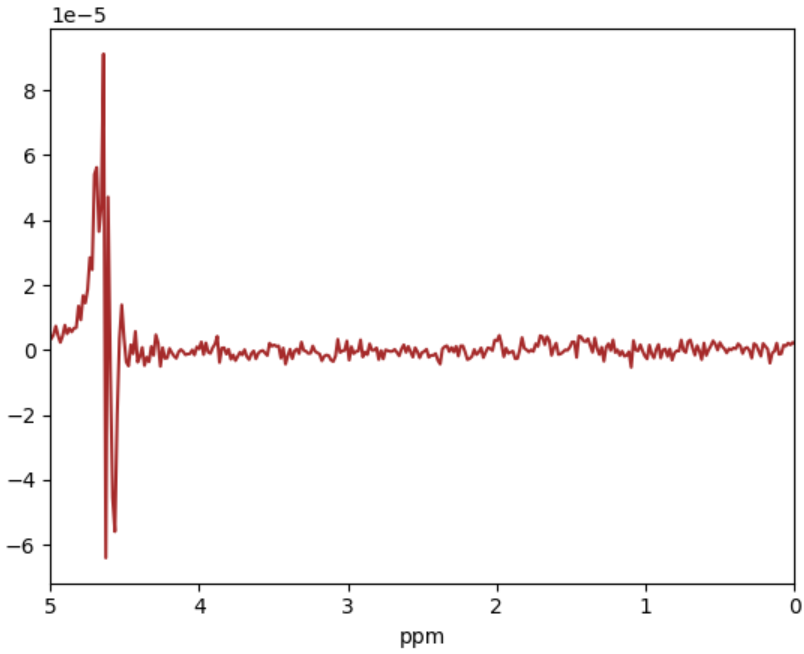
I am using the FID-A software to open a PRESS signal. The function I am using is this: io_loadspec_sdat("filename", 1). I am not sure whether the water reference is automatically considered in this function. If not, how can I include the water reference? For example, this is one of my signals opened using FID-A.
What are the parameters for this acquisition and where did you acquire from?
I do not see any metabolite signals in this spectrum, and doing eddy-current correction will not do anything to help you better resolve signals that aren’t there in the first place.
You need to optimize your acquisition first to a point where you can see them (you’ll generally want to zoom in to the region between 1 and 4.5 ppm after loading to avoid the residual water peak).
This dataset comes from a multivoxel acquisition, so some spectra are poor depending on the region. So in these cases, including or not including the water reference won’t make any difference?
For example, in general I usually open my acquisitions (especially Philips scans) without considering the water reference file. I use Gannet for MEGA-PRESS and FID-A for PRESS. Is that ok?
In Gannet, I know how to include the water reference file in the GannetLoad function, but in FID-A I have no idea how to do that.
I would suggest looking at the sample functions in the exampleRunScripts folder in the FID-A package; one of the run_pressproc... scripts might be a good place to start, although it’ll probably need a bit of adaption for multivoxel Philips data.
Most likely you’ll need two calls to io_loadspec_sdat : one to load the metabolite data, one to load the water reference – assuming you actually have water reference data (maybe less common for multivoxel acquisitions).
But, per @admin’s comments, you should be able to see the major metabolite peaks quite clearly already if you zoom in around 1-4.5 ppm range. If those aren’t apparent, the problem lies elsewhere and the water reference isn’t going to help!