I’m new to MRS, so apologies if this is a basic question. I’m trying to analyze a Siemens MEGA-PRESS (GABA editing) acquisition, but I’m confused by the exported data. For each run I only get one .IMA file in the sequence directory (e.g., MCGILL_MEGA_PRESS_1_0011 and MCGILL_MEGA_PRESS_2_0015 for two sessions respectively).The MRI operator told me this is “normal” and there is “no issue”.
However, from documentation/examples, Siemens “DICOM-structured IMA” MEGA-PRESS is often described as having many files (one per transient), while some pipelines (Gannet/Osprey) rely on transient-wise corrections. So I’m wondering whether my export has been combined/averaged by the scanner or by the DICOM export. And I’ve tried loading in Gannet (v3.5.1) using “GannetLoad”, One error I got was : “Input(s) must be entered as a cell array.”
My questions are:
Can Siemens MEGA-PRESS be exported as a single .IMA file that is already averaged/summed?
If it is already averaged, does that mean tools like Gannet/Osprey cannot do proper preprocessing (frequency/phase correction, drift correction, rejection, ON/OFF separation)?
For Siemens MEGA-PRESS exported as DICOM-structured IMA, should I normally expect separate transients/averages** (time series) and clear edit-ON vs edit-OFF conditions?
Any guidance on whether this export is typical and what the best next step is would be greatly appreciated. Thanks a lot!
I think the answer will largely depend on what kind of sequence, Siemens software version, and exam card settings have generated these data. Just to clarify, did you run two consecutive MEGA-PRESS scans, and each of them produced only one .ima file, or did you run one single MEGA-PRESS scan that generated two .ima files?
To your specific questions:
I think that even single .ima files can contain multiple transients (possible if the DICOM files are of the ‘enhanced’ rather than the ‘classic’ flavor), but it is also entirely likely that your two .ima files only contain the pre-averaged/summed edit-ON and edit-OFF spectra.
Yes, that is correct - it is highly discouraged to use pre-averaged data for precisely this reason, they’re very likely to contain subtraction artefacts.
Again, this will depend on the sequence, Siemens software version, and settings. I’m not sure what the official Siemens package can do nowadays; the CMRR (Minnesota) MEGA-PRESS can definitely export individual transients as individual .ima files, but requires an exam card check box to be checked.
In either case, you can still try and see if Osprey can load the data (see the documentation on how to set up a job file; for .ima data, simply point the files variable to the directory that contains them).
Not sure about the Gannet error, I’m suspecting you simply forgot to use curly brackets? The command needs to look like this (assuming you have both water-suppressed and unsuppressed scans and have stored them in entirely separate directories:
Thank you very much for your thoughtful and detailed reply — I really appreciate your help.
I realize that my previous description may not have been sufficiently clear, so I would like to clarify our situation more precisely.
We acquired two separate MRS sessions (i.e., two independent MEGA-PRESS acquisitions).
Importantly, each session produced only a single .ima file , and these files are very small in size, just 165kb. Based on this, it seems unlikely that the .ima files contain many individual transients or averages. Besides, it seems that there are not water reference data.
Regarding the sequence, we are using the McGill MEGA-PRESS sequence . I have also attached the available sequence-related files/screenshots. However, I am not very familiar with the internal implementation details of this sequence, particularly how individual transients are handled and exported into DICOM/IMA format.
And I encounter the following error when trying to load a single Siemens IMA (DICOM) MRS file:
Error using repmat
Replication factors must be integers.
Error in SpecifyOnOffOrder (line 73)
MRS_struct.fids.ON_OFF = repmat([1 0], [1 size(MRS_struct.fids.data,2)/2]);
Error in GannetLoad (line 394)
MRS_struct = SpecifyOnOffOrder(MRS_struct);
Given this context, I would be very grateful for your thoughts on the following points:
Does the fact that each session produces only one very small .ima file strongly suggest that the data are pre-averaged?
Is it possible for us to analysis this data? I will try to use fsl-mrs and OSPREY to cope with this data.
I have never seen this sequence before. Do you know who developed it?
One thing I noticed on the exam card:
There is an option called “Subtract ON/OFF scans” on the Special card. I suspect this might mean that the reconstruction only creates a difference spectrum that is then exported to IMA.
Gannet (and also Osprey) requires separate ON and OFF spectra; it is possible that the error you see arises from the fact that the IMA file contains only the difference spectrum. We can check with Osprey and/or FID-A; simply use the following commands to generate a plot of the data contained in the IMA file:
out = io_loadspec_dicom('$INPUTFILENAME');
op_plotspec(out);
Not having separate ON/OFF spectra (or a water reference) is also not optimal for reporting metabolite concentration estimates. Typically, you reference the GABA+ amplitudes to tCr from the edit-OFF spectra or to an unsuppressed water signal. If you only have the difference spectrum, the only compound to reference to is tNAA, which is less commonly used as an internal reference standard.
If you can still change the protocol, I’d try tinkering with the following settings:
System - Miscellaneous - Save single averages (This should save individual transients)
Sequence - Special - Subtract ON/OFF scans (See above - I suspect this prevents pre-averaging into DIFF spectra and preserve ON/OFF separately)
If you already have acquired a bunch of data with this protocol, you should be able to use FID-A to convert the IMA files to .RAW and fit them with LCModel (you’ll need a very suitable LCModel control file and a suitable basis set for this). FSL might also work (but not sure). We could make this work for Osprey in theory but I’m reluctant to make changes that can be fixed by setting correct exam card settings.
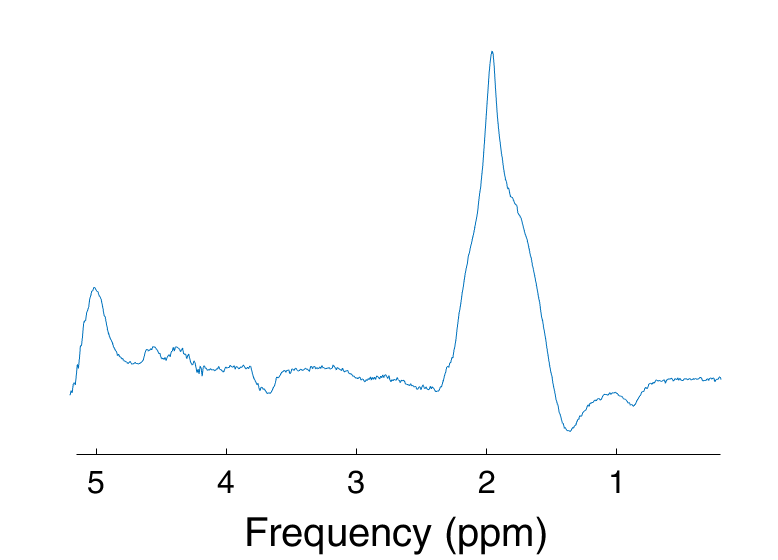
Thank you very much for your help. We will try to modify our protocol. Applying the code you provided, we observed no peak around 3 ppm, which is typically associated with GABA, and therefore believe that there may be an issue with this dataset.
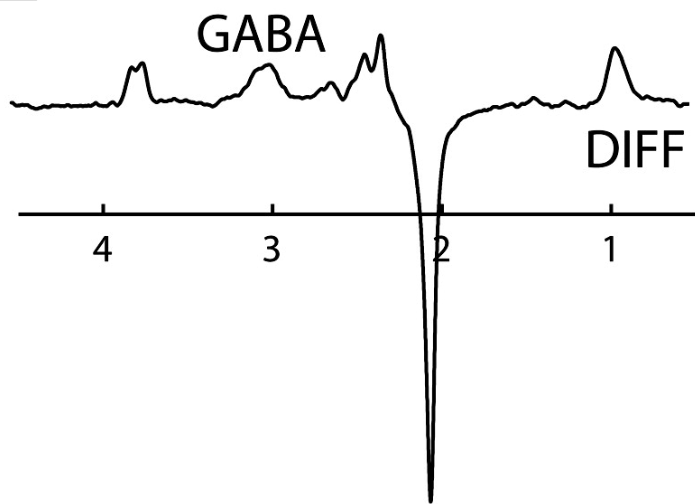
You can see the negative NAA singlet at 2 ppm, resulting from dephasing by the editing pulse, and also the characteristic edited signals from GABA+ (3 ppm), Glx/GSH (3.75 ppm), Glx/GSH/GABA (2.25 ppm), and MM09 (0.9 ppm). They’re somewhat visible in your data, but your linewidth is very poor. What brain region is this from and how do you shim? The absence of individual transients to align doesn’t help here; uncorrected drift can also result in apparent linebroadening upon averaging.