Hi, Can I take a standard MEGA‑PRESS GABA sequence and modify it to edit Glutathione instead of using a dedicated GSH sequence? Specifically, would it work if I simply change the editing‑pulse frequencies to 4.56 ppm (ON) and 7.50 ppm (OFF) with a bandwidth of 70 Hz? If this modification is valid, can I also use Gannet for the post‑processing?
Yes, you can simply move the edit-ON editing pulse frequency to 4.56 ppm and leave the bandwidth as it is.
Some papers recommend longer echo times for optimal GSH editing, but TE = 68 ms works pretty well too (Dikoma Shungu’s group has published multiple papers doing GSH editing at this echo time)
The answer whether you can use Gannet out of the box will depend on the choice of echo time, because the simplified Gannet model of the co-edited aspartyl does not generalize well to changes in echo time. If you want to use any kind of linear-combination model instead (LCModel, Osprey, FSL etc.), generating a TE-appropriate basis set will be pretty straightforward.
I would like to acquire muscle MRS using a TR of 3000ms and TE of 120 ms with 128 averages. I plan to focus on a single muscle to minimize B₀ inhomogeneity and reduce intramuscular heterogeneity. Do you have recommendations on the optimal muscle choice, voxel placement, or acquisition strategy for this setup?
Hi, In my MEGA‑PRESS GSH brain MRS data, the edited GSH peak appears near 3.10 ppm instead of the expected 2.95 ppm. Can you verify whether both the load, fitting and Quantify outputs (including the numerical values) are correct? Thanks GSH2.docx (529.6 KB)
there are subtraction artifacts in the spectrum. You can see them as sharp peaks at 2 ppm, 3 ppm, and 3.2 ppm.
Why do you use ‘Alignment’ = none? I would recommend changing it to ‘SpecRegDual’ in GannetPreInitialise.m. If the result is still bad, try other options listed in this file.
@mmikkel would you like to add the SpecRegDual to the list of available techniques? Sometimes it’s the best.
@narayanan76 Yes, did you set the alignment to none because spec reg wasn’t working? As @Andy suggested, you could try other options.
@Andy, so, SpecRegDual was developed a very long time ago and is now considered legacy code. We haven’t updated the code in years, which is why I don’t list it as an available technique.
Yes, SpecReg was giving an error. Attached is the word document where I tried all the alignment options. I see good fit for the Cr and Cho alignment. Which one should I use? Thanks again. With different alignment.docx (509.2 KB)
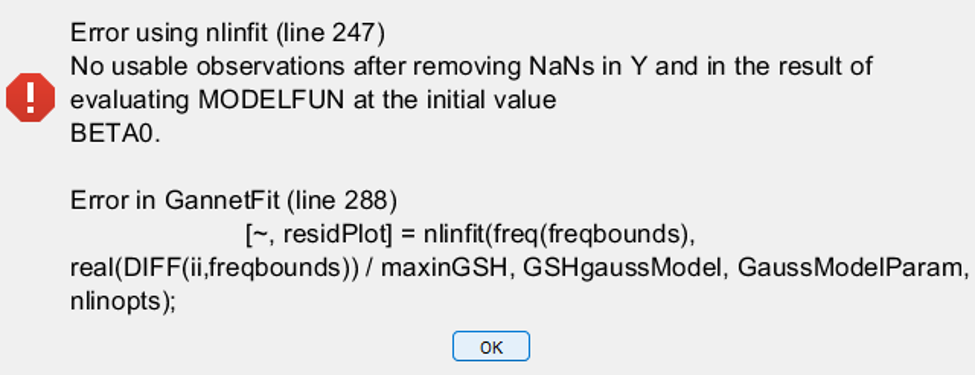
I think I had this error before, but it was a long time ago and I don’t remember how I fixed it. If it’s allowed to you to share a dataset I can try looking again.
Both Cr and Cho alignments don’t look confident to me, I would try fighting with SpecReg for a bit.
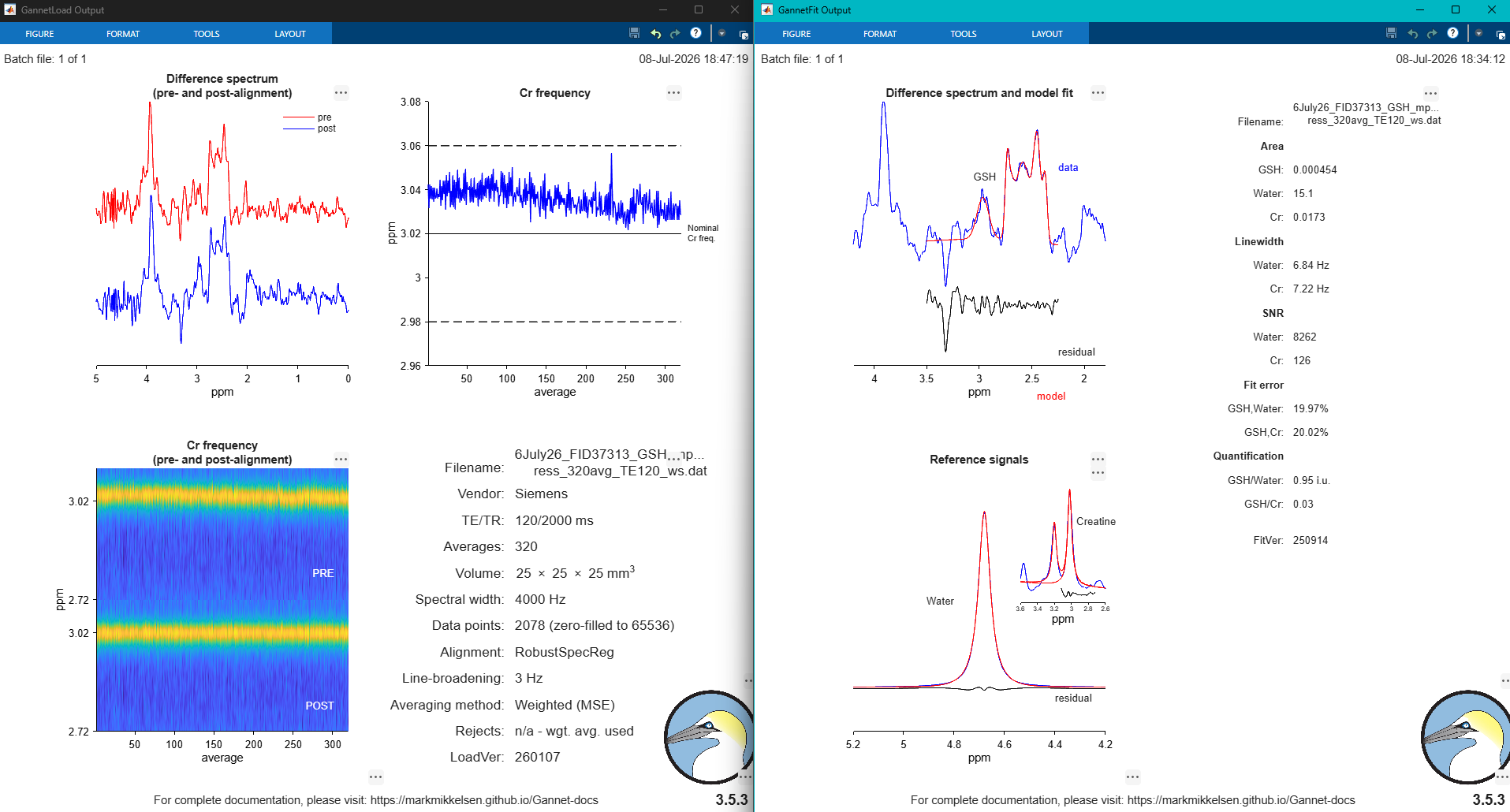
I checked your dataset: Gannet did not give any error at the fitting step. I used the last version Gannet 3.5.3.
See the RobustSpecReg load and Fit at the screenshot:
I’m still unhappy about the 2 ppm region, but the GSH peak is nice and I don’t see much residual Cho, so to me it looks Ok. The fit is acceptable.
Other aligning techniques were not better.
I would consider increasing the voxel size for a bit. The improved SNR of individual transients might help in aligning.
@narayanan76 That error occurs when the model fitting fails. From the SNR of your data, it was likely caused by not being able to fit the GSH peak. But it looks like updating your version of Gannet did the trick.